
Lake County Arrest History
An arrest creates a chain of related records. The arresting agency writes an incident or arrest report. If custody follows, Lake County Adult Corrections creates intake, booking, fingerprint, photograph, property, charge, and custody entries. Illinois State Police can receive identifying and charge data for its repository. The Circuit Clerk opens a judicial file only if prosecutors file charges.
Those records may not match word for word. Initial police labels can change after prosecutor review, and a court can dismiss a count or enter a different final result. Lake County arrest history therefore documents an accusation and custody event, not guilt. Municipal police keep their own reports, while the Sheriff handles reports made by deputies in unincorporated areas and its seven contract villages.
The Lake County records hub sorts public records by office and category.
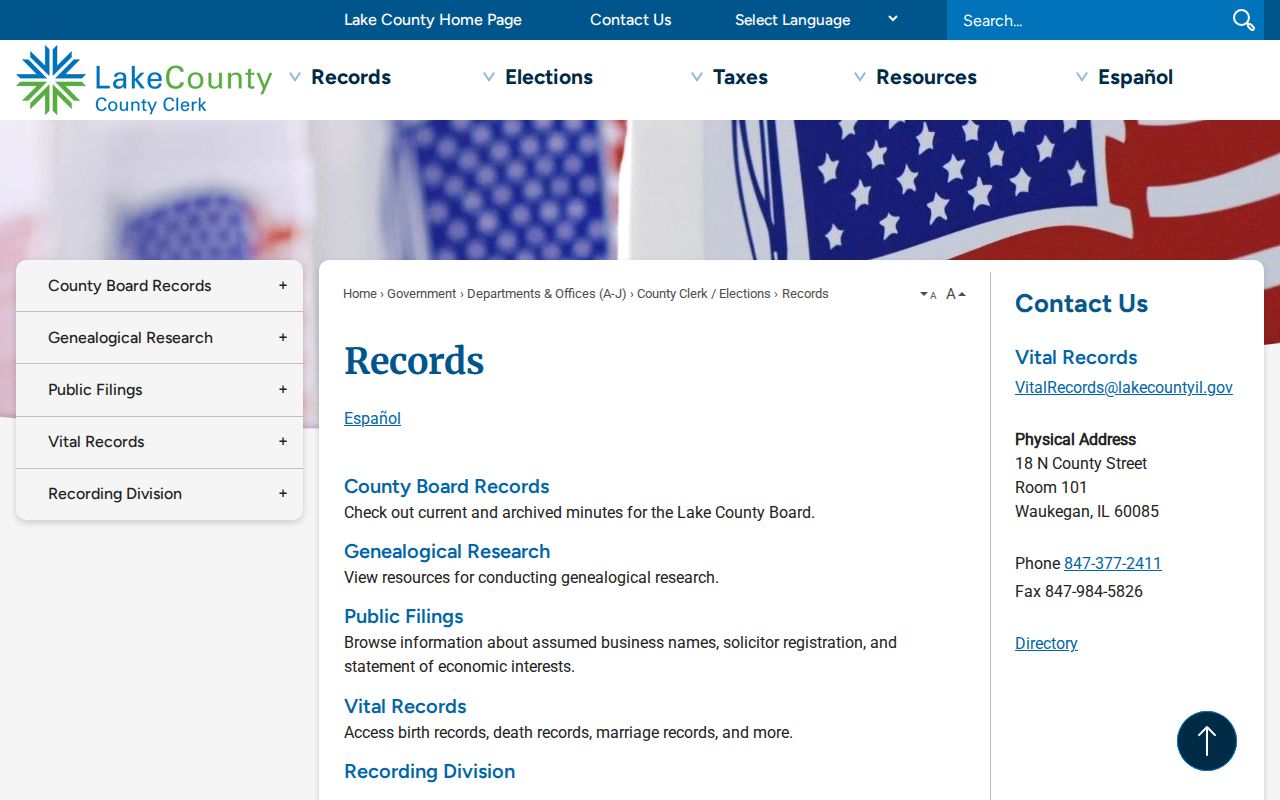
This routing page helps prevent a request for a police report from going to the court clerk or another wrong custodian.
Lake County Inmate Locator First
The embedded Lake County inmate locator is the first official check for present custody. Search promptly. Release or transfer can remove or change a result, and the static county page did not expose stable field labels that could be verified. No fields should be assumed. If the locator is unclear or unavailable, call Adult Corrections at 847-377-4150.
The locator is a custody tool, not a complete Lake County arrest history. It may show a person held now without revealing the full police narrative or final court outcome. An older booking may require Corrections FOIA. A sentenced person transferred to Illinois prison belongs in the IDOC Individuals in Custody search, while a federal transfer may require the Bureau of Prisons locator.
Looking Up Lake County Arrests
Use the channels in sequence, but stop once the record answers the actual question. Current custody, an arrest narrative, filed charges, and statewide conviction information are not interchangeable products.
- Check the Lake County inmate locator for present custody, then call Corrections at 847-377-4150 if the result is unclear.
- Identify the arresting agency. Ask that agency for its incident or arrest report; municipal reports are not held by Sheriff Records.
- Search the Circuit Clerk after charges are filed. Compare each filed count and disposition with the earlier booking entry.
- Use Illinois State Police channels for the state repository. Public UCIA access concerns conviction information, while personal Access and Review is the route for one's own full state record.
- Use Corrections FOIA for older county booking material, Sheriff FOIA for a deputy's report, IDOC after state transfer, and the federal locator where custody is federal.
VINELink can add custody or release notices. It does not replace the jail record or the court's disposition.
Lake County Sheriff Report Requests
The Lake County Sheriff's Records Section archives deputy reports, enters data for retrieval and analysis, completes required reporting, handles FOIA responses, and provides report access. Its direct number is 847-377-4200. The office covers Sheriff-generated records, including work in Beach Park, Deer Park, Lake Barrington, Long Grove, Mettawa, North Barrington, and Volo under county contracts.
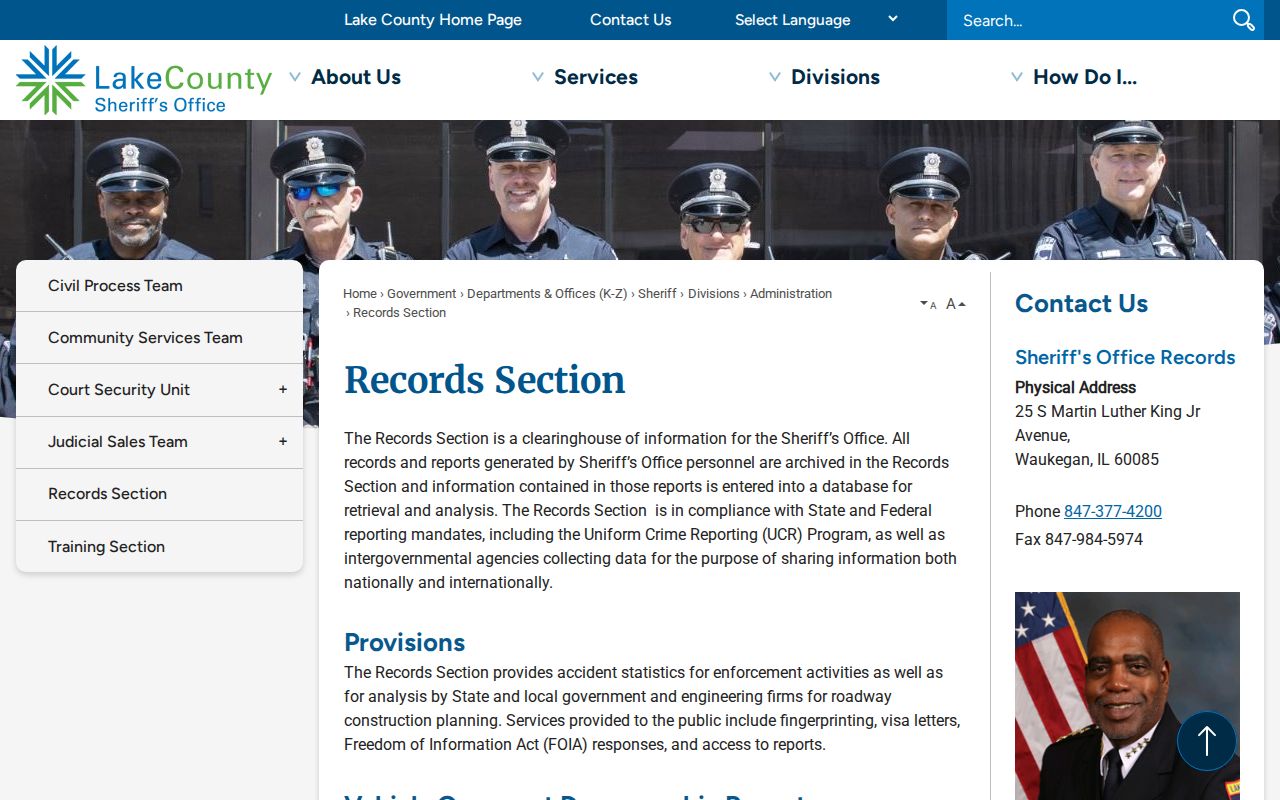
The Records Section page identifies the unit that can locate a deputy's narrative after the report clears review.
Lake County Sheriff's Records Section
25 S Martin Luther King Jr Ave
Waukegan, IL 60085
847-377-4200
FOIA email: sherifffoia@lakecountyil.gov
Fax: 847-984-5974
A city police arrest report stays with that city's records or FOIA office. State trooper, conservation, Metra, campus, and federal police reports likewise remain with the agency that created them, even if Lake County Adult Corrections handled the booking.
Inside a Lake County Arrest Record
Public arrest and booking records can identify the event, agency, first charges, custody path, and court route. Sensitive fields can be removed. Full birth dates, Social Security numbers, juvenile information, victim details, medical or classification data, and active-investigation content may be withheld or redacted.
| Agency number | The arresting agency's incident or arrest identifier |
|---|---|
| Event details | Date, time, place, arresting agency, and public basis for arrest |
| Booking number | The jail identifier tied to intake and custody processing |
| Booking time | Admission date and time, which can differ from arrest time |
| Charges | Offense labels presented at admission, subject to prosecutor and court change |
| Fingerprint and photo | Booking identifiers and image, with public release subject to law and policy |
| Release status | Release, transfer, pretrial detention, sentence, or other custody event |
Lake County does not need to republish booking photographs or accused names to explain these fields. The official custodian is the proper source for a specific record.
Lake County Report Approval Wait
The Sheriff recommends waiting five to seven business days after an incident before seeking the completed report. A deputy generally takes three to five days to finish it. Command staff then review the document before Records receives it. Asking too soon can produce no result even when an arrest occurred.
The official Sheriff report page explains the request timing and FOIA routes. Body-camera footage and other audio or video require a separate request. GovQA, email, mail, fax, and hand delivery are documented channels. FOIA requests should state the agency, date range, event or report number if known, people or locations involved, the precise record sought, and the preferred delivery method.
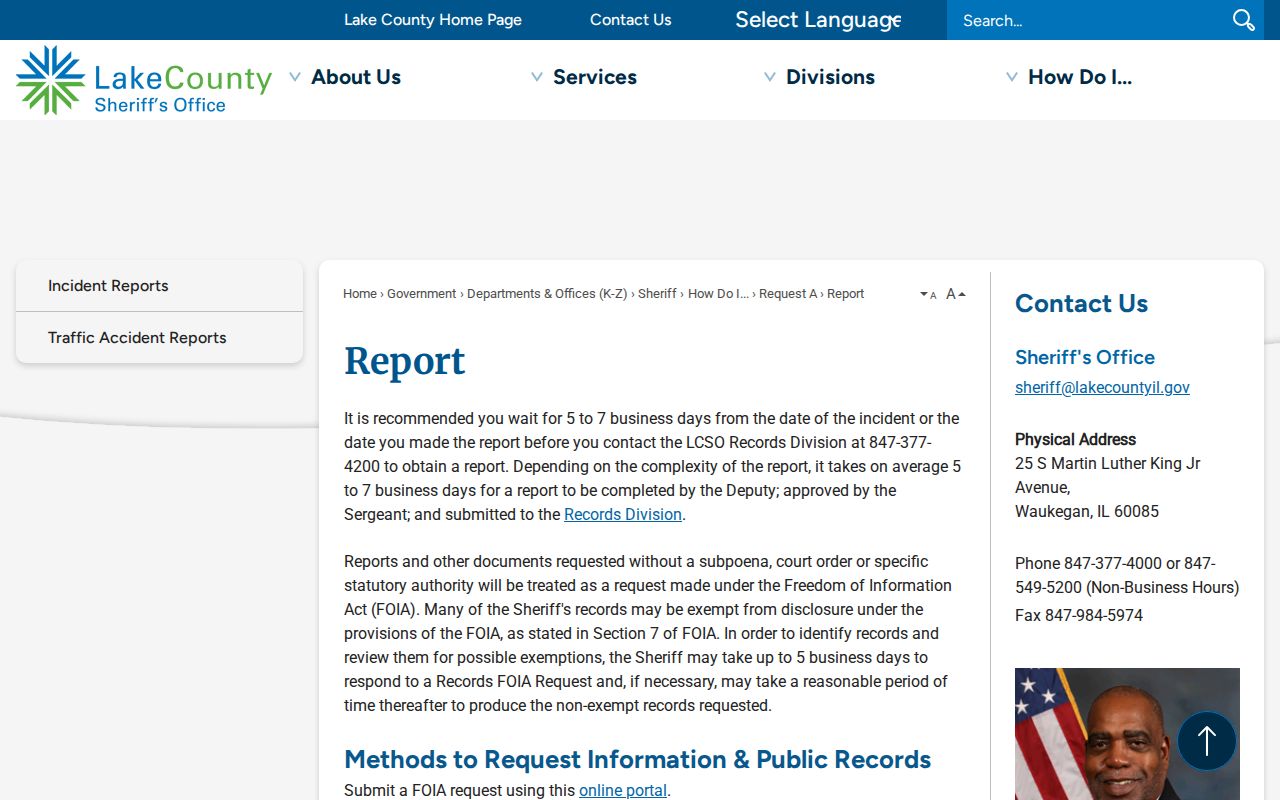
The request page shows why a formal record demand can succeed after a simple online check does not.
Note: A delayed report may still be under review, so use the event details and correct arresting agency when following up.
Booking Logs and Recent Arrests
Lake County does not provide one permanent arrest gallery. The inmate locator addresses current custody, and the Sheriff's official press releases provide dated public-safety reports about selected events. Neither is a complete historical list. A release can discuss an investigation, while the jail tool may change once a person leaves or moves.
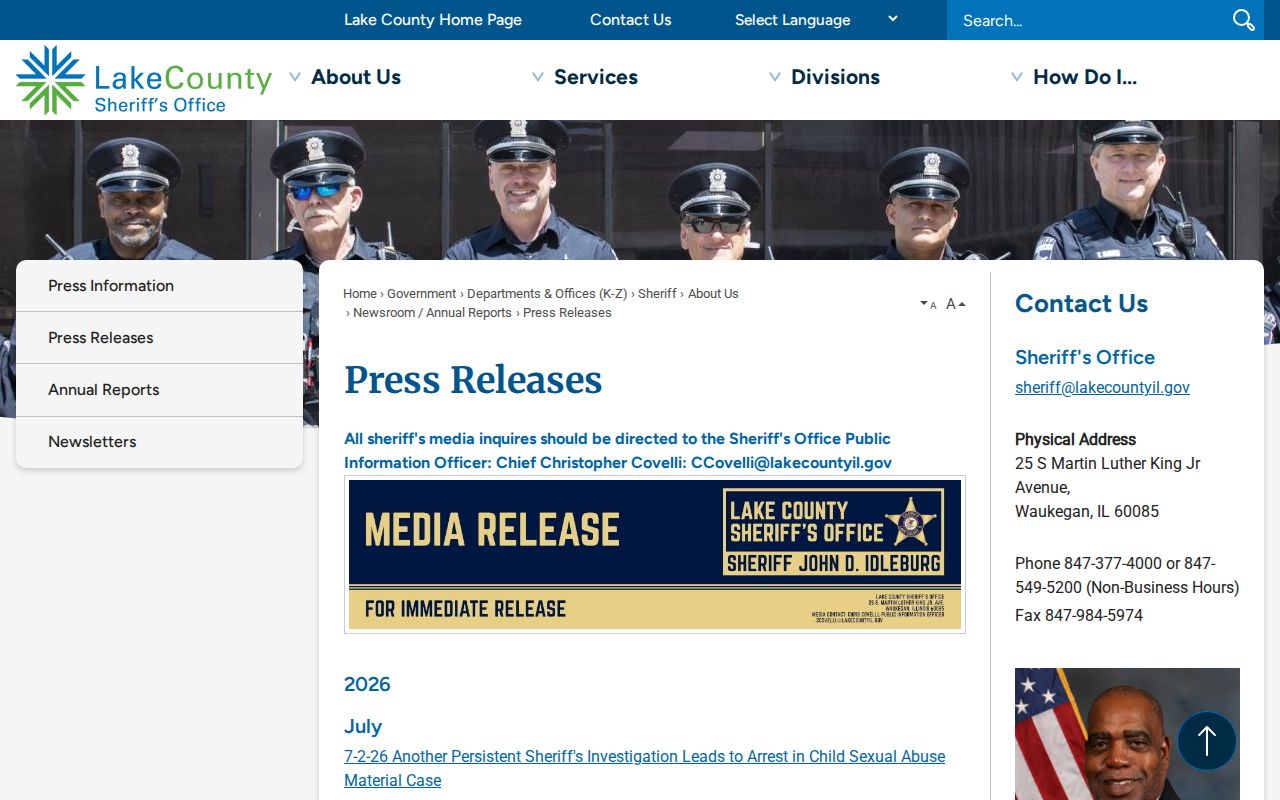
The release index is useful for event context, but readers still need the arresting agency report and court file for the formal record.
The county jail dashboard, developed with Loyola University Chicago, serves a different purpose. It shows population trends, age, race, ethnicity, gender, charge-level groupings, and reasons for custody. Use it for Lake County system context, not to look up a named person's outcome.
Lake County Custody After Transfer
Custody searches follow the institution, not the county where the arrest began. Lake County Adult Corrections covers present county detention. The Illinois Department of Corrections Individuals in Custody search covers people transferred to state prison. The federal Bureau of Prisons locator covers federal custody. Because Lake County also houses some people under a federal contract, call Corrections when the custodian is uncertain.
Corrections FOIA is the fallback for an older Lake County booking or custody record that no longer appears in the locator. It is separate from Sheriff Records FOIA because jail staff and deputy records staff keep different products. A request should name the booking or custody material sought and give a useful date range. For a police narrative, return to the arresting agency. For a final charge outcome, move to the Circuit Clerk.
VINELink provides custody and release notifications as a supplement.
Notifications can flag a change, but the jail, IDOC, BOP, and Circuit Clerk remain the sources for custody and case status.
The Lake County Sheriff's Office also announced a mobile app with jail information, inmate search, visitation, direct FOIA, report routing, tips, and press releases. The official announcement did not expose verified current store links, so no app listing is claimed.
Custody contact methods have changed as well. Lake County moved inmate mail to a digital process on May 27, 2025. Video visits can use terminals at the Community Based Correctional facility or remote internet visitation, and the jail hub links current phone, tablet, mail, account, and visitation rules. These services help with contact, but none proves the disposition of an arrest charge.
Lake County Pretrial Detention Terms
Illinois ended money bail for new cases under the Pretrial Fairness Act. Current Lake County records should be read in terms of pretrial release and court-ordered detention, not with the assumption that cash always produces release. The Sheriff's bond page still contains instructions tied to legacy or particular orders, so confirm what the actual judicial order allows before relying on that page.
A booking record may show a court or pretrial order, but the judicial docket is the better source for the controlling terms. Lake County added clerks, pretrial staff, interpreter support, Public Defender positions, and Sheriff court resources during the transition. Those changes help explain why newer arrest records and older bond records may use different language.
Arrests Are Not Convictions
A Lake County arrest record proves that an agency recorded an arrest or booking. It does not prove guilt. The prosecutor may decline to file a charge, amend it, or file a different one. The court may dismiss a count, acquit the accused, enter supervision, accept a plea, or impose a sentence. Only the court file shows that judicial path.
| Point | Arrest record | Conviction record |
|---|---|---|
| Creator | Arresting agency and jail | Circuit Court and state reporting system |
| Meaning | An accusation and custody event | A court finding or accepted plea of guilt |
| Local source | Agency records unit and Adult Corrections | Lake County Circuit Clerk |
| Possible end | Release, transfer, no charge, or filed case | Sentence, appeal, sealing, or later relief |
For the filed charges and final result, use the Lake County criminal court case record and read the disposition for each count.
Note: An arrest is not proof of guilt, and many arrest charges change or end without a conviction.