
Lake County Criminal Court Cases
The Circuit Court of the Nineteenth Judicial Circuit is Lake County's trial court. It has original jurisdiction over felony and misdemeanor cases. The Circuit Clerk, not the County Clerk, is the official keeper of the judicial file. That distinction matters because the Sheriff's Office keeps arrest and incident reports, while the clerk keeps the court's docket, filed charges, orders, and outcome.
Most felony files and the central records operation are in Waukegan. Assigned traffic and misdemeanor matters may be heard at branch courts in Mundelein, Park City, or Round Lake. Juvenile cases use a Vernon Hills branch and have tighter access rules. The venue shown on a notice or docket should guide where a reader calls, but the clerk remains the records custodian for Lake County criminal court cases.
The official court page shows the Lake County justice system and its facilities.
That court hub is the sound first stop for current calendars, clerk links, and courthouse details.
Lake County Criminal Case Venues
A file's court location reflects how the Nineteenth Judicial Circuit assigned the matter. The main Waukegan complex handles felonies, central records, and specialty programs. Branches handle assigned lower-level matters. A person seeking one file should use the case number and the venue on the docket instead of assuming that every hearing occurs in the Criminal Court Tower.
| Venue | Contact | Typical role |
|---|---|---|
| Waukegan, 18 N County St | Clerk 847-377-3380 | Felonies, central records, specialty courts |
| Mundelein, 105 E Route 83 | 847-377-3300 | Assigned traffic and misdemeanor matters |
| Park City, 301 Greenleaf St | 847-377-3500 | Assigned branch matters |
| Round Lake, 1792 Nicole Ln | 847-377-3400 | Assigned branch matters |
| Vernon Hills, 24647 N Milwaukee Ave | 847-377-7888 | Restricted juvenile cases |
Call before travel if the docket location or access status is unclear. The Criminal Court Tower at 301 Washington Street has courtrooms, while the public clerk counter is at 18 N County Street.
Searching Lake County Case Records
Lake County's official Circuit Clerk Online Portal is the normal local online route, but it was reported unavailable on the research inspection date. The outage does not end public access. The clerk offers a $6 search for each name and year, file or document requests for known case numbers, a basement public-viewing counter with photo identification, storage retrieval for older offsite files, and certified copies through eCertify, mail, or the counter.
Use the strongest identifier available. A full name and year can support the paid clerk search. A case number is better for a file, document, or certification request. When a portal result returns later, confirm the venue and status before relying on a single docket line.
| Search input | Best use | Access note |
|---|---|---|
| Full name and year | Clerk record search | $6 per name per year |
| Case number | Specific file or document | Use Request a File or Document |
| Photo ID | Basement public counter | Needed for in-person viewing |
| Older file reference | Storage Retrieval | For material held offsite |
| Certification request | Official copy | eCertify, mail, or counter |
Note: Online absence does not prove that a Lake County criminal court case or an older paper file does not exist.
When Lake County Search Is Down
Start with the Circuit Clerk rather than a commercial database. Ask for the name-and-year search if no case number is known. If the number is known, request the file or the exact document. The basement counter is the direct viewing route, and Storage Retrieval covers older records that are no longer onsite. These channels answer different needs, so a request for a certified judgment should say that plainly.
The county's outage note also explains why no private sample file was inspected for this build. No portal fields were guessed. Once access returns, useful fields should include the case number, filing date, case type, status, parties, charges, statutes, docket events, hearing dates, disposition by count, sentence, financial entries, and linked documents. Until then, clerk staff can identify the proper channel without treating the unavailable portal as the whole record system.
Inside a Lake County Case File
A court file tells what prosecutors filed and what judges did. It may differ from the arresting officer's initial charge labels. Read each count through its last disposition, since one count may be dismissed while another ends in a plea, trial finding, supervision, or sentence. Docket entries provide a timeline, but the linked order or judgment is often the clearest source for the legal result.
| Case identity | Case number, filing date, case type, venue, and status |
|---|---|
| Participants | Parties, counsel, judge, and prosecuting office when public |
| Charges | Filed count, statute, offense class, and amendments |
| Docket | Hearings, motions, orders, warrants, and release or detention events |
| Outcome | Disposition by count, plea or finding, and dismissal details |
| Sentence | Custody, probation, supervision, fines, and post-judgment events |
| Documents | Public linked filings, orders, and certified-copy options |
Some fields can be sealed, redacted, or restricted. Juvenile material, victim details, and active investigative information do not become open merely because another part of the docket is public.
Read Lake County Case Outcomes
Illinois docket terms are easiest to read count by count. A filed charge is an allegation. A disposition is the court's result for that count. Court supervision is a court disposition with conditions and is not the same thing as probation. Probation follows a judgment under its own terms, while detention describes custody before or during the case. Lake County now uses current pretrial release and detention terms, so old cash-bail assumptions can misstate a new case.
- Arraignment
- The hearing at which filed charges are addressed and a plea is entered.
- Disposition
- The final court result for one charge or count.
- Court supervision
- A conditional Illinois outcome that differs from a probation sentence.
- Pretrial detention
- Judge-ordered custody before disposition under current Illinois procedure.
- Post-judgment
- Activity after disposition, such as enforcement, review, or an appeal.
Where the court outcome matters, inspect the judgment or final order rather than stopping at an old charge description.
How a Criminal Case Moves
Lake County criminal court cases can begin with an arrest report or a prosecutor's filing. If a person is detained, booking precedes the first appearance. The State's Attorney then reviews the facts and may file a complaint or information, seek an indictment, alter the proposed charges, or decline to proceed. Counsel, discovery, and motions shape what comes next.
Charges Filed → Arraignment → Pretrial → Plea or Trial → Disposition → Sentencing
The sequence is a reading aid, not a promise that every case uses every step. A dismissal may end a count early. A negotiated plea may avoid trial. An appeal or other post-judgment event can add later docket entries. The broader Lake County arrest lookup process explains why the arrest file and court file may begin with different charge language.
The Lake County State's Attorney page identifies the office that reviews and prosecutes charges.
The image connects the charging stage to the public office responsible for prosecution, not to the clerk that keeps the docket.
Lake County Specialty Court Dockets
Courtroom T-711 gives Lake County criminal case records a distinct weekly pattern. Its published schedule lists Mental Health Court on Monday, fitness calls and hearings on Tuesday, Alternative Prosecution and Drug Court on Wednesday, and expungement calls on the second and fourth Thursdays. STOP matters use the first and third Thursdays. Veterans Court and fitness hearings appear on Friday.
The programs also have a documented history. Drug Court began in July 2005, Mental Health Court in January 2007, and Veterans Treatment and Assistance Court in 2011. Participation can create program, review, and completion entries in a docket, but it does not by itself erase the file. Read the ultimate order and disposition.
The Lake County Public Defender page explains appointed defense services and court-date help.
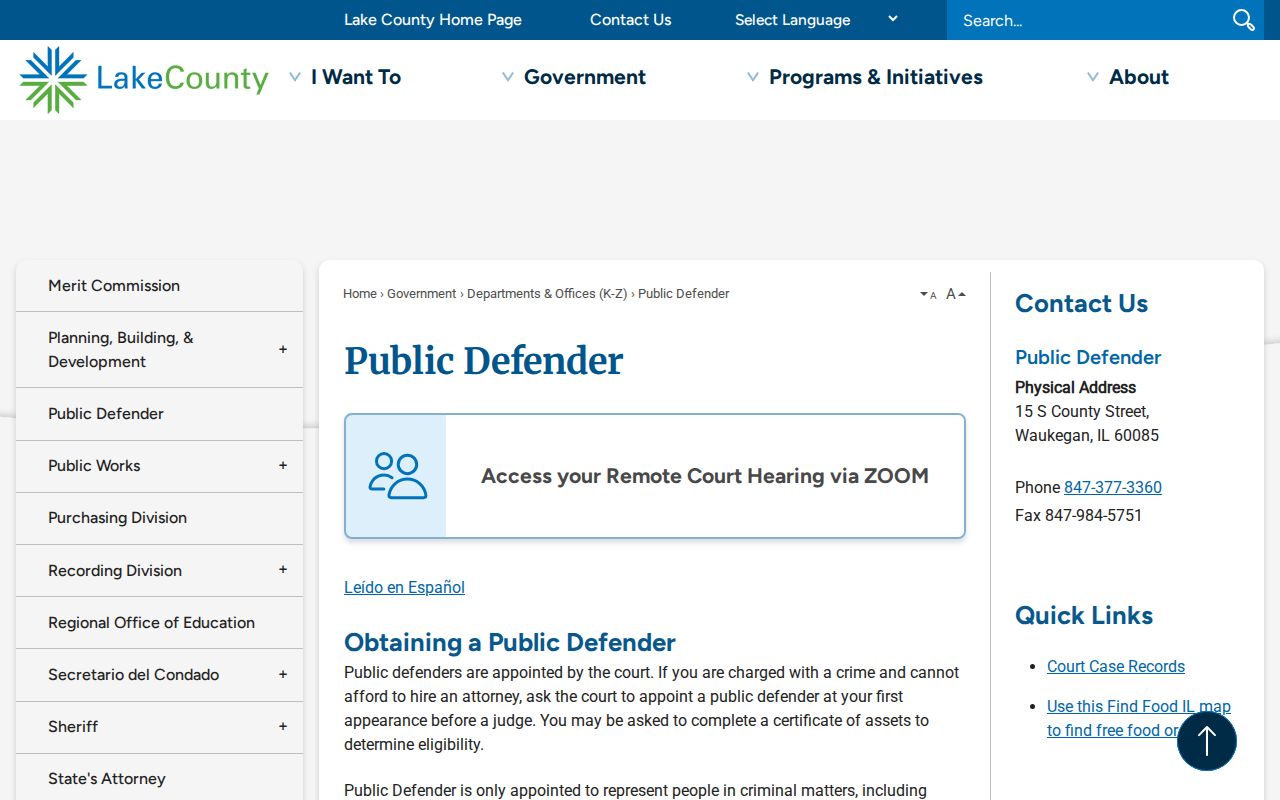
This office serves eligible charged people, while the Circuit Clerk remains the source for public court records.
Federal Cases Outside Lake County
A federal prosecution does not appear as a Lake County Circuit Court case. Lake County lies in the Eastern Division of the U.S. District Court for the Northern District of Illinois, and regular proceedings occur at the Dirksen U.S. Courthouse in Chicago. Federal firearms, controlled-substance, fraud, corruption, and interstate task-force cases create a separate federal docket.
The official PACER system provides federal docket and document access. Registration is free. PACER charges 10 cents per page, caps most case-specific documents and reports at $3, and waives a quarterly bill of $30 or less, though some reports and transcripts are not capped.
PACER is the official federal route and should not be confused with Lake County's local Circuit Clerk system.
The Northern District of Illinois page identifies the federal court serving Lake County.
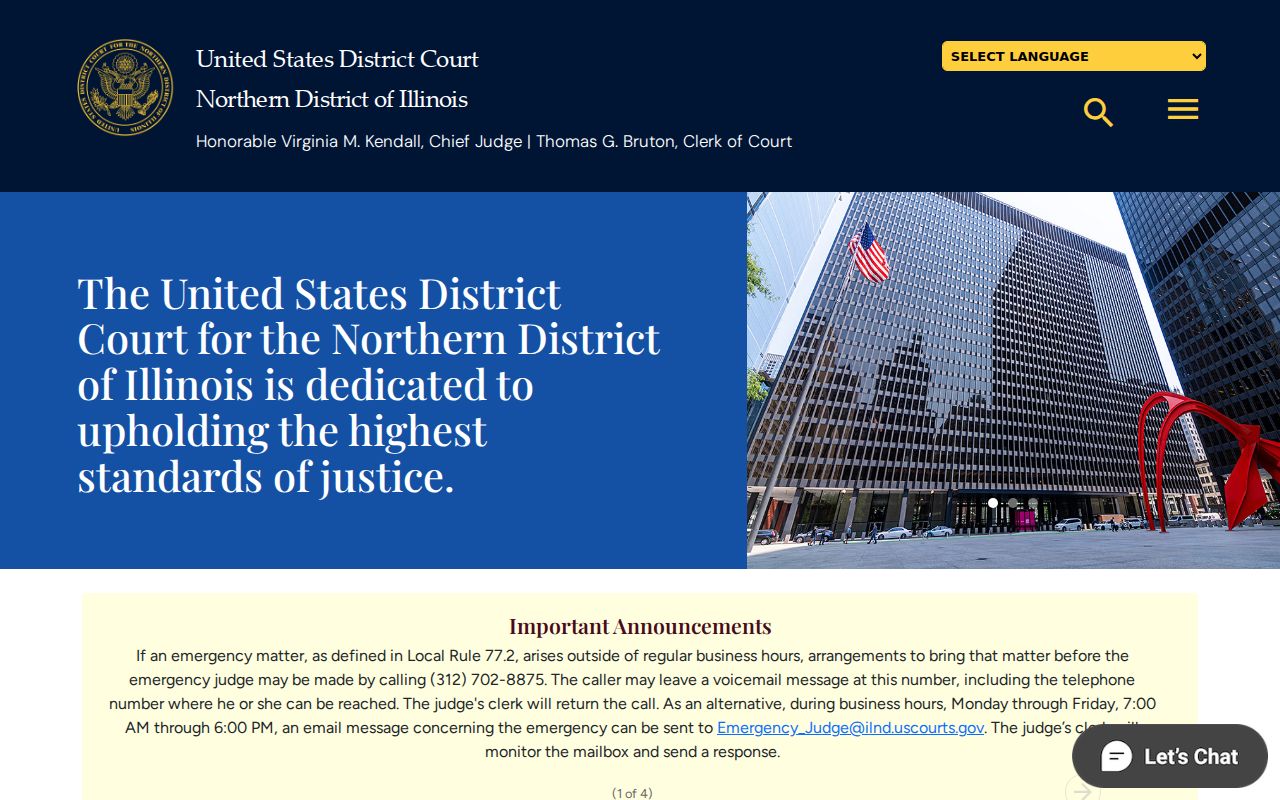
The federal court image marks the jurisdictional break between a county prosecution and a federal prosecution.
Case Record Access & Restrictions
The Illinois Freedom of Information Act does not turn the judicial branch into an ordinary county FOIA desk. Court records are obtained through the Circuit Clerk and court access rules. The online portal, name-and-year search, public counter, mail, storage retrieval, eCertify, and document-request paths are the verified Lake County channels. Choose based on whether the goal is discovery, viewing, a plain copy, or a certified copy.
Sealed files, expunged records, juvenile cases, grand-jury material, victim information, and protected investigative content may be unavailable or redacted. A missing online result can also reflect an outage, an older offsite file, a name mismatch, or delayed data. It is not proof that no proceeding occurred.
Note: Ask the clerk which copy type is needed before paying, since viewing, plain copies, and certified copies serve different purposes.